How to Build a Mindful Meal Routine That Lasts
Build a mindful meal routine in small steps: a pre-meal check-in, a realistic pace, mid-meal fullness checks and goals you can keep. Start with one meal a day.

A mindful meal routine is a short, repeatable sequence you run at the same meal each day: a pause before you eat, a steady pace while you eat, a fullness check halfway through, and a quick note afterward. Start with one meal, keep the steps small, and let the pace come from the meal in front of you instead of a generic rule. That last part is where Stummy fits: it reads a photo of your meal and sets a pace for that plate, with no calorie counting.
TL;DR
- Start with one meal or snack a day, not every meal. Add length and meals as the habit holds.
- Use three checkpoints: before (hunger check), during (pace and fullness check), after (a short note).
- Treat 20 minutes as a useful guide, not a law. The research has not set an exact cutoff.
- Set small, measurable goals and review them weekly.
- Mindful eating reliably improves behaviors like pace and fullness awareness. Judge your routine by those, not by the scale.
Table of Contents
- What a mindful meal routine actually is
- Why pace is the backbone
- Build the routine in five steps
- Set mindful eating goals you can keep
- How to stay on track when life gets busy
- What to expect from the routine
- Promo: let each meal set its own pace
- Perspective
- FAQ
- Sources
What a mindful meal routine actually is
Harvard’s Nutrition Source describes mindful eating as nonjudgmental awareness of the eating experience: what you sense, and what you think and feel about food. It also notes there is no standard protocol. That is good news for you. You are not following a program that you can fail. You are building a few habits that suit your day.
A routine matters because attention fades. Kripalu’s Jess Frey describes mindful eating as a practice you return to again and again, a breath and a bite away. Nobody stays present for every bite. A routine gives you a reliable place to come back to.
Why pace is the backbone
Pace is the easiest part of mindful eating to act on. Cleveland Clinic’s Dr. Heinberg explains the logic: a fast eater takes in more food in 20 minutes than a slow eater, so by the time fullness signals arrive, they have already overeaten and feel uncomfortable. A 2020 review notes the stomach takes around 20 minutes to signal the brain about fullness.
Is the 20-minute rule real?
It is a sensible guide with no hard cutoff. The same review says no study has established how long a meal should last. Henry Ford Health says a meal probably should be more than 20 minutes and suggests setting aside about 30. BBC Food, citing the review’s author, reports that 10 to 20 minutes is usually considered ideal. So use 20 minutes as a direction. A light snack should take less time than a full dinner, which is why a single fixed timer often feels wrong.

Signs you are eating too fast, per Henry Ford Health, include bloating after meals, feeling hungry soon after eating, and taking the next bite before you finish chewing. If you want practical tactics, our guide on how to eat slower lists twelve.
Build the routine in five steps
1. Pick one anchor meal
Kripalu suggests starting with one snack or meal a day, ideally eaten alone at first, because full attention is easier without conversation. Choose the meal that is most predictable. For many busy professionals that is lunch, and our piece on eating slowly on your lunch break covers it in detail.
Harvard also recommends not skipping meals and eating at similar times. A consistent time makes the routine a cue instead of a decision.
2. Run a pre-meal check-in
This is your mindful eating check-in, and it takes under a minute:
- Put the phone down and take a few deep breaths.
- Ask: am I physically hungry, or am I bored, stressed or reacting to the smell of food? NC State Extension suggests separating true hunger from external cues.
- Rate hunger on a simple scale, such as 1 to 10, so you can compare it with fullness later.
Kripalu recommends the same sequence: a hunger and fullness check before the first bite. If the answer is stress rather than hunger, our guide to identifying mood eating triggers helps you name the pattern.
3. Clear the table of distractions
Health Canada warns that eating while distracted, such as in front of a TV, can increase how much you eat and drink. It recommends electronics-free meals at a table. Johns Hopkins adds that if you are eating in a car, wait until you are parked.
If your phone keeps pulling you away, this piece on stopping phone distraction without willpower offers ideas for setting up your environment so you do not have to fight the urge. For what distraction does at the table, see our article on distracted eating.
4. Eat at a steady pace and check fullness midway
This is the core of the routine. Put your fork down between bites, chew thoroughly, and notice texture, temperature and flavor. Johns Hopkins suggests starting with just one or two mindful bites, then setting a timer for five minutes per meal and building longer each week.
Halfway through, pause and repeat your hunger rating. Harvard’s practices include eating slowly and stopping at about 80% full. Smaller bites help the pace, and we cover how in taking smaller bites. When you are unsure where fullness starts, how to stop eating when you’re full walks through the cues.
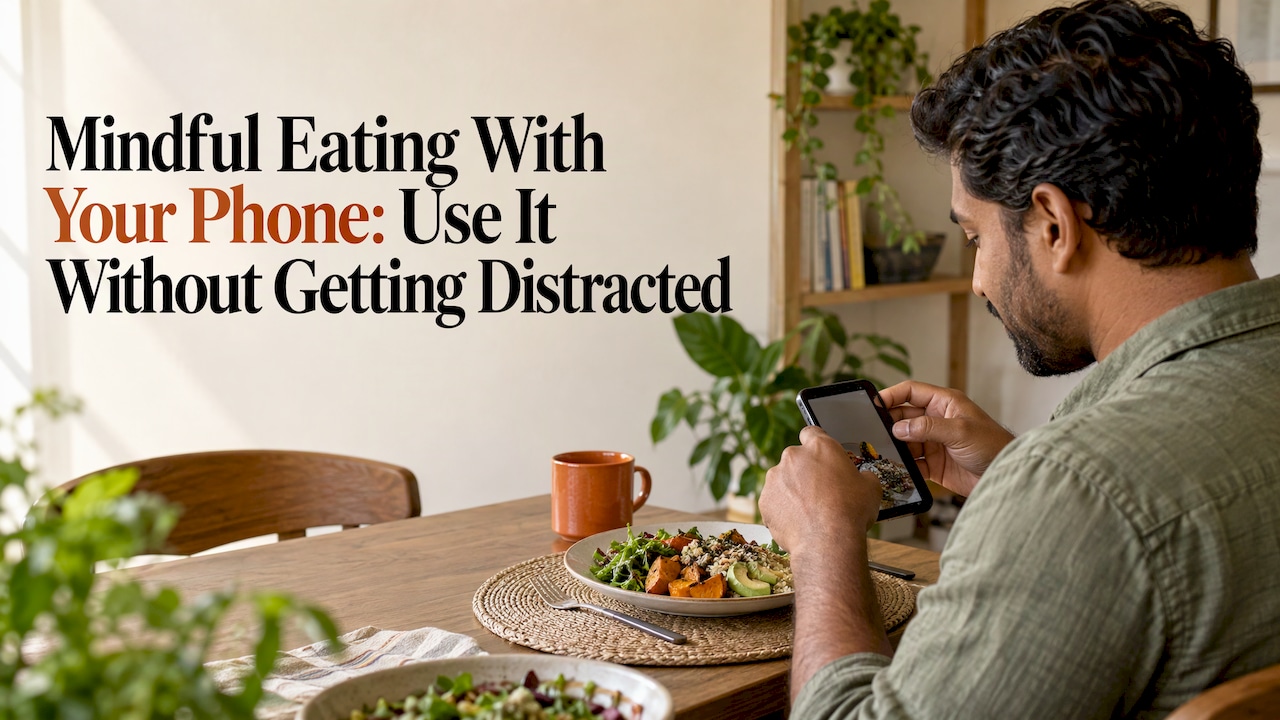
This is the step where a tool helps most, because pace depends on what you are eating. Stummy analyzes the food type, portion and texture from a photo and builds a pacing guide for that meal. It adds haptic bite cues so you can stay off the screen, and mid-meal fullness checks that prompt the pause you would otherwise forget.

5. Close with a 30-second note
After the meal, record how full you feel, how long it took and what your mood was. A pattern appears quickly: rushed lunches leave you hungry by three, calm dinners leave you comfortable. Stummy tracks your history and offers mood-based insights, and its targets adapt as your habits change.
Set mindful eating goals you can keep
Vague goals such as “eat more mindfully” fade by Thursday. The American Heart Association recommends SMART goals: specific, measurable, achievable, realistic and time-bound. Applied to meals:
| Weak goal | SMART version |
|---|---|
| Eat slower | Put my fork down between bites at lunch, Monday to Friday, for the next four weeks |
| Be more present | Eat lunch without my phone for 10 minutes, then add 2 minutes each week |
| Stop overeating | Do a fullness check at the halfway point of dinner on five nights this week |
The Johns Hopkins progression, a five-minute timer that grows weekly, fits this format well.
How to stay on track when life gets busy
Consistency beats perfection. Cleveland Clinic’s dietitian compares a daily plan to a GPS: you may take a detour, but you get back on track sooner. The same page suggests eating well about 80 to 85 percent of the time and scheduling smaller meals about three hours apart so you are not ravenous at the next one.
A few ways to make the routine survive a hard week:
- Shrink the routine, do not skip it. On a packed day, keep only the pre-meal breath and one fork-down pause.
- Plan meals loosely. A flexible structure for the week, like these meal planning tips, means you are less likely to grab whatever is nearby and eat it in four minutes.
- Tie it to a cue. Sit down, phone away, three breaths. The same sequence every time.
- Use a reminder. Our busy-schedule guide covers how to fit the routine around meetings. Stummy includes reminders and a home widget for this.
- Add accountability. Sharing progress with someone can keep a habit going, as this accountability guide explains.
Use pauses when emotion drives the meal
Johns Hopkins explains that for emotional or stress eaters, mindful eating helps because it builds pauses and awareness of internal hunger cues, which prevents eating on autopilot. If tiredness from restrictive dieting feeds the pattern, this article on dieting fatigue is worth reading. For a step-by-step approach, see how to stop stress eating and mindless eating.
What to expect from the routine
Be realistic about results. Harvard’s review of 68 studies found mindful eating improved behaviors such as slowing meal pace and recognizing fullness, and worked best for reducing binge and emotional eating. Weight did not change consistently, and the studies were small and short. In a trial of 194 adults, a mindfulness-based program alongside diet and exercise led to improved fasting glucose at 18 months.
So measure your routine by what it changes: how often you stop comfortably full, how long meals take, how you feel an hour later. Individual results vary.
Promo: let each meal set its own pace
Stummy is a free mobile app for pacing your meals. Snap a photo and it analyzes the food type, portion and texture to create a pace for that meal, with live sessions, haptic bite cues, mid-meal fullness checks and adaptive targets, all without tracking calories. Join the waitlist for early access at stummy.app.

Perspective
Most people do not fail at mindful eating because they lack willpower. They fail because the advice is generic. A fixed timer treats a salad and a steak sandwich the same, and a rule that does not fit the plate gets abandoned.
We built Stummy around the idea that pace should come from the meal itself. A photo tells us the food, the portion and the texture, and from that we set guidelines that adapt with every meal. The cues arrive as haptics, so your eyes stay on your food, not on a screen.
Our approach is gradual habit change, not calorie counting. Slower eating promotes satiation, and a routine that checks in before, during and after the meal makes that easy to practice. Individual results may vary, and a small habit repeated beats a perfect plan that lasts a week.
VEID
FAQ
How do I stay mindful during meals when I am busy?
Shrink the routine instead of dropping it. Put the phone away, take three breaths and put your fork down between bites for the first few minutes. Johns Hopkins suggests noticing when your attention drifts and gently returning it to the food.
How long should a mindful meal take?
There is no proven cutoff. Cleveland Clinic recommends more than 20 minutes, ideally about 30, for a regular-sized meal. Smaller snacks naturally take less time.
How do I stick to mindful eating goals?
Make them specific and small, such as one meal a day for four weeks, and review them weekly. Build length gradually, and treat a missed day as a detour, not a failure.
Does mindful eating help you lose weight?
Research shows it improves pace, fullness awareness and binge or emotional eating, but results on body weight are inconsistent. Many people use it to feel more comfortable and in control at meals.
Sources
- Mindful Eating, The Nutrition Source (Harvard)
- Seven Tips to Mindful Eating Practice (Kripalu)
- Fast Eater? 4 Tips To Help You Slow Down (Cleveland Clinic)
- How To Practice Mindful Eating (Cleveland Clinic)
- Eating speed and the risk of type 2 diabetes (PMC)
- Are You Eating Too Fast? (Henry Ford Health)
- Is eating quickly bad for your health? (BBC Food)
- 12 Steps for Mindful Eating (NC State Extension)
- Take time to eat (Health Canada)
- Mindful Eating: What It Is and Tips to Get Started (Johns Hopkins Medicine)
- Mind Over Matter: Developing Mindful Eating Habits (American Heart Association)
- Effects of a mindfulness-based weight loss intervention (Obesity, 2016)