How to Take Mindful Breaks During Meals
Learn how to pause mid-meal, run a quick check-in on hunger, fullness, taste and mood, and fit it into a busy day, with steps backed by research.

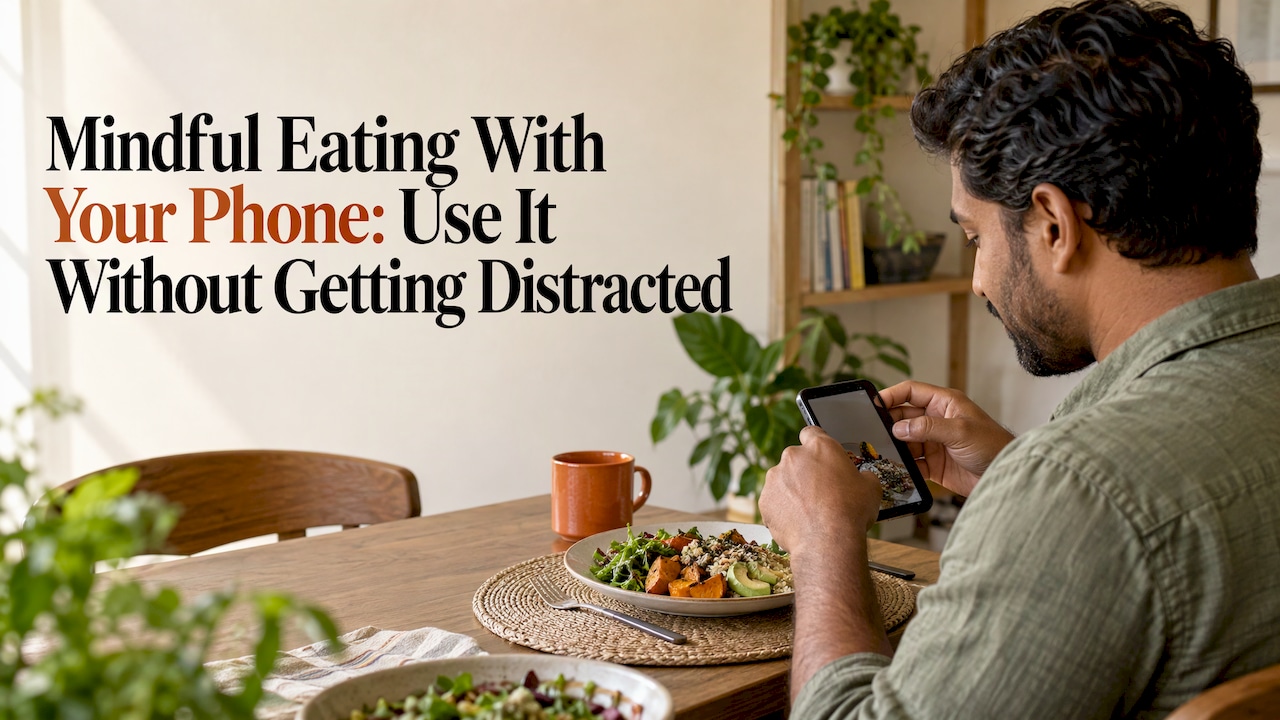
A mindful break is a short pause in the middle of a meal: you put the fork down, take a breath and ask how hungry you still are, how the food tastes and how you feel. It takes under a minute, needs no rules and works at a desk or at a table. The hard part is remembering to do it while you are busy, and that is where Stummy, our free app, helps: it sets a pace for each meal from a photo and gives haptic bite cues and mid-meal fullness checks, so the pause arrives without you watching a clock.
TL;DR
- Pause once around the halfway point of a meal and rate your hunger and fullness. The University of Washington’s Whole U describes this as a gentle check-in that supports natural portion awareness.
- Aim for comfortably full, a 6 or 7 on a 0 to 10 scale, rather than painfully full.
- Fullness signals take time to reach the brain, so a pause gives them room to catch up.
- Start small: one or two mindful bites, or a five-minute timer, then build up.
- Stummy’s mid-meal fullness checks and haptic cues are built to prompt the pause for you, without calorie counting.
Table of Contents
- What a mindful break actually is
- Why a pause helps
- The two-minute mid-meal check-in
- Making it work on a busy day
- Where a pace-setting app fits
- Promo: try the pause with Stummy
- Our perspective
- If pausing feels awkward
- FAQ
- Sources
What a mindful break actually is
Mindful eating means bringing full attention to the experience of eating: slowing down, noticing your senses and checking in with hunger and fullness. The Whole U stresses that it is not a diet and has no restrictions, and that small changes, such as a few breaths before eating or a pause halfway through, can make a meaningful difference.
A mindful break is the smallest version of that idea. You are not meditating over your lunch. You stop eating for a moment, look at what is left and notice what is going on in your body and mind. Then you decide whether to carry on, slow down or stop.

Why a pause helps
The reasoning is simple physiology. Stomach stretch receptors and appetite hormones from the small intestine send fullness messages, but it can take 20 minutes or longer for the brain to register fullness, which makes it easy to overeat without realizing it. Health Canada adds that eating quickly can stop you from knowing when you are full, and that eating while distracted, for example in front of a TV, can lead to larger portions or losing track of how much you ate.
Research on slower eating points the same way. In a 2008 study of 30 healthy women, slow eating lowered intake within the meal (579.0 vs 645.7 kcal) and raised satiety at the end. A 2017 trial of a smartphone-delivered mindful eating program with 104 women found a 40.21% reduction in craving-related eating over 28 days.

Results vary from person to person. A small 2020 study of 24 people noted that meals may need to last about 20 minutes to affect satiety, and a review of 68 studies summarized by Harvard found mindful eating improved behaviors like meal pace and recognizing fullness, with the clearest benefit for binge and emotional eating. The practical takeaway: judge the habit by how you feel at the end of the meal, not by a number on a scale.
The two-minute mid-meal check-in
Here is a version you can run in the middle of any meal. It borrows from the sequence in the UC San Diego Centers for Integrative Health check-in and the VA’s mindful eating guidance.
- Put your utensils down and breathe. Take two or three slow breaths. Setting the fork down is itself a pacing tool; Health Canada lists it among its tips.
- Rate your hunger. The VA’s mindful eating sheet uses a scale from 0 (starving) to 10 (painfully full). Are you still hungry, or already comfortable?
- Taste a bite on purpose. Notice color, smell, texture, flavor and temperature. The VA suggests noticing whether your enjoyment is rising or falling as the meal goes on.
- Notice mood and setting. Are you eating from hunger, or from stress, boredom or habit? Is a screen or an email pulling your attention?
- Decide. If you want more, check in again and ask whether you need the food or are eating out of habit or stress. UC San Diego frames the same question.
A dietitian at BSW Health suggests a fullness check about 10 minutes into a meal, aiming for a 6 or 7, then one more after you finish. She also notes that fullness cues are quieter and easier to miss than hunger cues, which is exactly why a scheduled check-in helps.
What to notice, at a glance
| What you check | The question to ask | Why it matters |
|---|---|---|
| Hunger and fullness | Where am I on 0 to 10? | Comfortable fullness is easy to miss when eating fast |
| Pace | Did I put the fork down between bites? | Gives fullness signals time to arrive |
| Taste | Am I still enjoying this as much as the first bite? | Enjoyment fading can be a cue to stop |
| Mood | Am I eating from hunger or from stress? | Separates need from habit |
| Distraction | What is pulling my attention? | Distracted eating can mean losing track of how much you ate |
Making it work on a busy day
You do not need a long, quiet meal. Johns Hopkins Medicine suggests starting with one or two mindful bites, setting a five-minute timer for a meal and building longer the next week. Its mindfulness program director advises that when you notice a distraction, you simply shift attention back to the food for a moment or two.
For a short break, Harvard nutrition lecturer Lilian Cheung told NPR’s Life Kit that the rule of thumb is at least 20 minutes per meal. With only 15 minutes, she suggests eating at a comfortable pace and saving part of the meal for a later snack, and setting expectations with coworkers if you eat at your desk.
Some ways to fit the pause into real days:
- At your desk: step away from the workstation and keep mealtime free of electronics, as Health Canada recommends. Our guide to eating slowly on your lunch break goes through it.
- With other people: move your attention between the conversation and the food, as Johns Hopkins suggests.
- In the car or on the move: wait until you are parked before eating. More ideas are in our piece on eating on the go.
- When the schedule is packed: our mindful eating on a busy schedule guide shows how to shrink the practice rather than skip it.
If the pause tends to disappear once you are hungry and rushed, it helps to pair it with smaller bites; see how to take smaller bites and slow down when you eat too fast.
Where a pace-setting app fits
The usual obstacle is not knowing what to do. It is forgetting to do it. A generic timer treats a salad and a thick burrito the same way. Stummy looks at a photo of your meal and analyzes the food type, portion and texture, then creates a pace for that meal. Targets adapt as you log more meals.
During a meal, haptic bite cues nudge you without a screen to stare at, and a mid-meal fullness check prompts the exact pause described above. Afterward, history tracking and mood-based insights show how your pace and mood relate. Stummy does not track calories, and it is free to use.
Promo: try the pause with Stummy
If you want the mid-meal check-in to happen without effort, Stummy gives you live sessions, haptic bite cues, mid-meal fullness checks, reminders and a home widget in one free app. You can join the waitlist for early access at stummy.app.

Our perspective
Most people do not eat fast because they do not care. They eat fast because the day is crowded and nothing in the meal tells them to stop and look up.
We built Stummy around that gap. A pause is easiest to keep when it arrives at the right moment for the food on your plate, which is why our pace comes from your meal photo, not from a one-size timer. Cues through touch keep your eyes on the meal and off a screen, and the fullness check asks the same simple question a dietitian would: how do you feel right now?
We also think the habit should feel good. Mood insights and adaptive targets are there so mealtime becomes something you notice and enjoy, not another thing to measure. Early research suggests slower eating supports satiation, and individual results vary. That is why we focus on gradual change you can keep.
VEID
If pausing feels awkward
Some people find the pause uncomfortable at first, especially when they are eating with others or are used to eating on autopilot. Make it smaller rather than dropping it. Try the one-or-two-bite start from Johns Hopkins, or just set the fork down between bites for a few minutes. Keep the check-in to a single question, such as “Am I still enjoying this?”
If focusing on food, hunger or fullness stirs up distress, or you have a history of an eating disorder, talk with your doctor or a registered dietitian before using hunger and fullness scales. Mindful eating is meant to be gentle, so go at a pace that feels okay.
For more on why attention drifts, read about distracted eating and mindless eating. To get a feel for amounts, see portion size awareness, and for pace in general, how to eat slower.
FAQ
How often should I pause during a meal?
Once around the halfway point is a good start. A dietitian at BSW Health suggests a check about 10 minutes in and another after you finish. Add more pauses only if they feel natural.
How long should a mindful break last?
A breath or two and a quick hunger rating can take under a minute. The longer UC San Diego sequence runs several minutes, so use it when you have time and the short version when you do not.
What if I only have 15 minutes to eat?
Eat at a comfortable pace and save part of the meal for later, as Lilian Cheung suggests. Even a one-bite pause helps.
Do mindful breaks lead to weight loss?
The evidence is mixed on weight. Harvard’s summary of a 68-study review found improved eating behaviors such as pace and fullness awareness, but not consistent weight change. The more reliable gains are in how the meal feels and how well you notice fullness.
Sources
- Mindful Eating, The Whole U (University of Washington)
- Mindful Eating, The Nutrition Source (Harvard T.H. Chan)
- Nutrition Briefings, UC San Diego Centers for Integrative Health
- Mindful Eating, U.S. Department of Veterans Affairs
- Hunger-fullness scale, BSW Health
- Take time to eat, Health Canada
- Slow down and try mindful eating, Harvard Health
- Mindful eating tips, Johns Hopkins Medicine
- The importance of mindful eating in a fast world, NPR
- Comparison of mindful and slow eating strategies, PMC (2020)
- Mobile mindful eating intervention, PMC (2017)
- Eating slowly and energy intake in healthy women (2008)