How to Feel Satisfied After Meals: What Actually Works
Why meals sometimes leave you wanting more, and how pace, food choices and fullness checks help you feel satisfied after eating, without counting calories.
Satisfaction after a meal comes from three things working together: what is on the plate, how fast you eat it, and whether you notice the signals your body sends while you do. Most people fix only the first. The pace is often the missing piece, because fullness signals lag behind the fork. Stummy is a free app that reads a photo of your meal and sets a pace for that specific plate, so slowing down stops being guesswork.
TL;DR
- Fullness takes time to register: Cleveland Clinic says it can take up to 30 minutes for the brain to catch up with the stomach.
- Protein, fiber and vegetables make a meal more filling per bite, so smaller portions can still satisfy.
- Eating slowly is linked to greater fullness later and fewer snack calories, so pace is worth treating as a skill.
- Check in mid-meal by asking whether you are still hungry, not whether you are stuffed.
- Distraction, poor sleep and skipped meals all push you toward wanting more after you eat.
Table of Contents
- Why you can finish a meal and still feel unsatisfied
- Build a plate that fills you up
- Slow down: the part most people skip
- Check in during the meal
- A routine that fits a busy day
- Where Stummy fits
- Our perspective
- FAQ
- Sources
Why you can finish a meal and still feel unsatisfied
A meal can leave you wanting more for reasons that have nothing to do with willpower. Healthline lists the common ones: meals low in protein or fiber, eating too fast, distraction, stress, lack of sleep and not eating enough earlier in the day.
The biology matters here. Protein prompts the release of fullness hormones such as GLP-1, and fiber slows digestion. Sleep matters too: a 2022 Swedish study reported by BBC Science Focus found one night of sleep deprivation lowered leptin (a fullness hormone) and raised ghrelin (a hunger hormone).
Then there is timing. Stomach stretch and hormones need time to reach the brain, so you often become physically full before you feel it. That is why a rushed meal can end with a sense that nothing happened, followed by a search for something sweet twenty minutes later.
Feelings count as well. Cleveland Clinic’s Dr. Albers notes that fullness is only partly physical: disliking a meal can leave you wanting more, and a dining companion saying they are full can make you feel full too. If hunger seems tied to mood rather than the stomach, our guide to identifying mood eating triggers helps you sort one from the other.
Build a plate that fills you up
Satisfaction starts with what you eat. Healthline’s portion guide suggests these moves:
- Fill at least half the plate with non-starchy vegetables, which add volume with fewer calories.
- Include protein at every meal and snack, since protein increases fullness more than carbs or fat.
- Drink water with the meal.
- Start with a vegetable soup or salad.
- Add soluble-fiber foods such as oatmeal, beans, chia seeds and pears, which form a gel that slows digestion.
The evidence is encouraging. In one study cited there, people started a meal with soup and ate 20% fewer calories across the whole meal. Another cited a 2012 study in which meals with 20 to 30% of calories from protein produced more fullness than meals with half that protein.
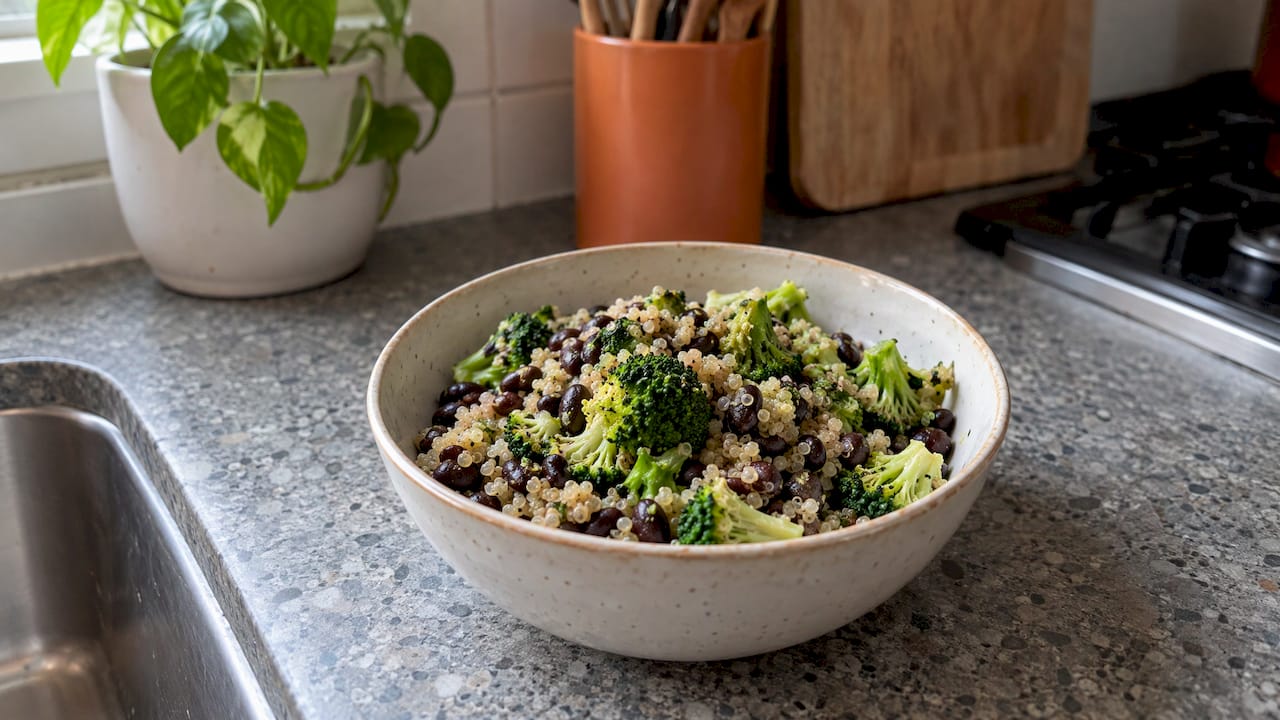
Cleveland Clinic’s list of foods that keep you fuller longer includes almonds, avocados, broccoli, cottage cheese, raspberries, black beans, lentils, oats, pears and quinoa. It also suggests keeping a personal list of the foods that keep you satisfied for hours. If you want ideas for building a filling plate, this 25g plant protein bowl shows how protein and vegetables come together.
Smaller portions can feel just as full
You may not need more food, only a better-built plate. A Kaiser Permanente study published in March 2026 compared standard restaurant portions under 700 calories with regular meals. Diners eating the standard portions consumed 482 calories on average versus 829, yet their fullness ratings differed by less than a tenth of a point on a 7-point scale. The smaller meals contained more vegetables, and 93% of those diners said they would order them again.
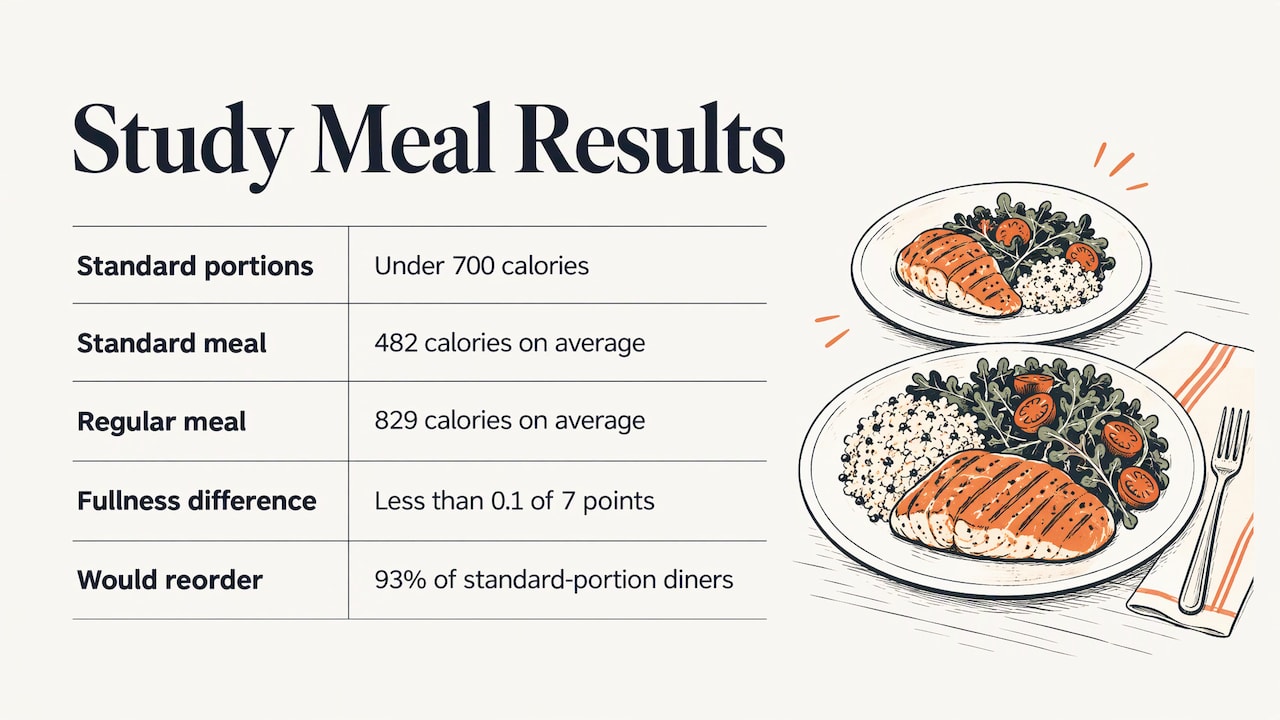
Plate size plays a part too. Healthline reports that people tended to fill their plates about 70% full regardless of plate size, so a 10-inch plate held 52% more food than an 8-inch one. The NIDDK likewise suggests smaller dishes, bowls and glasses.
You do not need a scale for this. Our guides on controlling portions without weighing and judging portions by eye and photo walk through it. A simple visual method, such as the hand portion method, can also help you plan portions without feeling deprived.
Slow down: the part most people skip
Pace changes how a meal feels afterward. In a 2018 study in Nutrients, people ate the same 600-calorie meal in either 6 or 24 minutes. The slow eaters felt fuller two hours later, showed greater suppression of ghrelin, and ate 25% less energy from snacks three hours after the meal.
A 2008 study of 30 healthy women found similar results: they ate 579 calories when eating slowly versus 646 when eating fast, drank more water, and rated the meal as more satisfying and pleasant.
Harvard’s Nutrition Source reviewed 68 studies and found mindful-eating strategies improved behaviors like slowing down and recognizing fullness, with slower eating linked to eating less because people felt full sooner.
There is a sweet spot. The 2018 study’s authors noted that the faster eaters enjoyed the meal more in the moment, which suggests there is a comfortable window of pace, and that tolerance for slower eating may grow with practice. The aim is not to crawl through dinner. It is to find a pace that is slow enough for fullness to register and still pleasant.
Practical ways to pace a meal
- Aim for 20 to 30 minutes. Cleveland Clinic describes fast eating as finishing a regular meal in under 20 to 30 minutes and suggests a timer to stretch meals to about 30 minutes.
- Put the fork down between bites and chew each mouthful 15 to 30 times, per the same guidance.
- Sip water every few mouthfuls.
- Switch hands. Henry Ford Health dietitian Bethany Thayer suggests a non-dominant hand or chopsticks.
- Turn off the screen. A 2024 study cited by Men’s Health found that the more distracted people were at meals, the less satisfied they felt and the more they snacked later.
A fixed timer is a blunt tool, though. A salad and a bowl of dense rice and chicken do not need the same pace. Our overview of meal pacing app features explains what helps in practice.
Check in during the meal
A mid-meal check turns pace into awareness. Cleveland Clinic suggests rating hunger from 1 to 10 before, during and after eating, aiming to finish in the 4 to 7 range. Alberta Health Services recommends starting around 3 to 4 and stopping around 5 or 6, which it describes as satisfied and comfortable.
Two habits make this easier:
- Ask a different question. Instead of “Am I full?”, ask “Am I not hungry anymore?” Dr. Albers describes satiated as meeting a need, not filling every inch of space.
- Split the plate. Utah State University Extension suggests dividing food into halves or thirds and checking in before the next section.
Cleveland Clinic also offers the PAUSE exercise: put on the brakes, assess hunger from 1 to 10, understand your needs, slow down, and entertain your options. If you still want something afterward, Men’s Health quotes gastroenterologist Roshini Raj, MD, advising a wait of 20 to 30 minutes before snacking.
For more on reading these signals, see satiety signals, hunger versus appetite and how to stop eating when you are full. If the habit of finishing everything is what overrides your cues, try the steps for stopping the clean plate habit.
A routine that fits a busy day
Skipping meals sets up the next one to disappoint. Cleveland Clinic recommends a consistent eating schedule, and the NIDDK advises regular meal times and avoiding meals in front of the TV or while busy with other things.
A workable weekday version looks like this:
- Eat at roughly the same times each day, so you arrive at the table hungry but not ravenous.
- Build the plate: half vegetables, a palm of protein, a fiber-rich carb.
- Put the phone and laptop out of reach for the first ten minutes.
- Pause once halfway and rate your hunger.
- Wait before seconds. Fullness may need at least 15 minutes to register, according to the NIDDK.
For a closer look at what your plate actually holds, our piece on portion size awareness is a good companion.
Where Stummy fits
Stummy turns the advice above into something you can follow at the table. You snap a photo of your meal, and the app analyzes the food type, portion and texture to build pacing guidance for that plate. It offers live sessions, haptic bite cues so you are not staring at a screen, mid-meal fullness checks, adaptive targets, history tracking, mood-based insights, reminders and a home widget. It works without tracking calories.
The app is free, with no in-app purchases or subscriptions, and the main call to action is joining the waitlist for early access at stummy.app.

Our formula is designed to adapt targets with every meal rather than relying on a generic timer. Early research shows slower eating promotes satiation, though individual results may vary.
Our perspective
Satisfaction is a skill you can practice, and it starts with attention. Most of us were taught to finish what is served and to judge a meal by how stuffed we feel afterward. Both habits push us past the point where we were simply done.
We built Stummy around one idea: the right pace is different for every plate. A crisp salad, a dense pasta and a bowl of soup ask for different rhythms, so a single timer misses the point. That is why we start from a photo of the meal, and why our targets adapt as your habits change.
We also think the experience should stay out of your way. Haptic cues keep your eyes off the screen and on your food, and mid-meal fullness checks ask the one question that matters: are you still hungry? No calorie counting, no scoreboard, just a calmer meal that you enjoy more.
VEID
FAQ
How long does it take to feel full after eating?
The brain can take up to 30 minutes to register fullness, according to Cleveland Clinic. The NIDDK puts it at least 15 minutes. That is why finishing a meal in five minutes often leaves you unsatisfied.
Why am I hungry right after a meal?
Common causes include too little protein or fiber, eating too fast, distraction, stress, poor sleep and skipping meals earlier in the day. Try adding protein and vegetables, slowing your pace and eating at regular times.
Can I feel full with smaller portions?
Yes, when the plate is built well. In the 2026 Kaiser Permanente study, diners eating standard portions with more vegetables reported nearly the same fullness as those eating larger meals. Starting with soup or salad and eating slowly also helps.
Should I eat until I feel full?
A better target is satisfied, meaning no longer hungry. Alberta Health Services suggests stopping around 5 or 6 on a 1 to 10 scale, comfortable rather than stuffed.
Sources
- Feeling Hungry After Eating: Why It Happens and What to Do (Healthline)
- Why you feel still hungry after eating (BBC Science Focus)
- How To Tell When You’re Full (Cleveland Clinic)
- 8 Tips to Reduce Food Portions Without Increasing Hunger (Healthline)
- When more isn’t more: Smaller restaurant portions (Kaiser Permanente)
- Food Portions: Choosing Just Enough for You (NIDDK)
- Slow Down: Behavioural and Physiological Effects (Nutrients, 2018)
- Eating Slowly Reduces Energy Intake, Increases Satisfaction (HealthDay)
- Mindful Eating (Harvard Nutrition Source)
- Fast Eater? 4 Tips To Help You Slow Down (Cleveland Clinic)
- Are You Eating Too Fast? (Henry Ford Health)
- Why You’re Hungry After Eating (Men’s Health)
- Hunger and Fullness Signals (Alberta Health Services)
- Learning to Listen to Hunger and Fullness Cues (Utah State University Extension)